Direct links, regional schemes and new settlement arrangements are changing the economics of moving money across borders — but compliance and FX remain the hard parts.
Why the correspondent model persisted
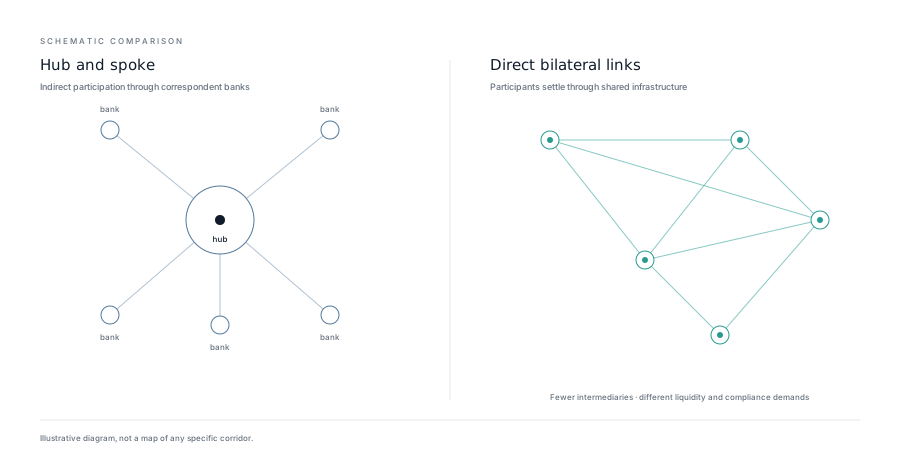
Cross-border payments have historically depended on chains of correspondent banks. Each link provides access to a local clearing system, foreign-exchange capacity and compliance judgment. The model is indirect, opaque on pricing and slow at the tail, but it solves a real problem: not every bank can be present in every market.
Criticism of the model often conflates three separate issues: cost, speed and transparency. Direct connectivity can improve all three for a specific corridor without producing a general solution. The general solution requires interoperable standards, shared compliance data and settlement arrangements that work across currencies.
Direct links and regional schemes
Regional payment schemes have made progress by reducing the number of intermediaries inside a defined area. Where participating institutions share a common rulebook and a common settlement currency, the result can be faster and cheaper than a correspondent chain.
Extending that logic globally is harder. Currency conversion, sanctions screening, local licensing and dispute resolution do not disappear when the message is standardised. They move to a different part of the process.
Stablecoins and tokenised settlement
Stablecoin arrangements promise near-instant transfer and programmability. They also raise questions about reserve quality, redemption rights, anti-money-laundering controls and the legal finality of a transfer in different jurisdictions.
For regulated institutions, the interesting question is not whether a token can move value. It is whether the arrangement provides the same certainty as a settlement account, and whether the issuer is supervised in a way that makes that certainty credible.
Compliance is the binding constraint
Most cross-border friction is not caused by the payment message. It is caused by the need to establish who is involved, where the funds came from and whether the transaction is permitted. Duplicated screening across the chain produces cost and delay without necessarily improving outcomes.
Progress depends on better data standards, clearer liability rules and supervisory cooperation. Technology can support that work; it cannot substitute for agreement on the rules.
A practical agenda
For banks and payment institutions, the near-term agenda is unglamorous: map the corridors that matter, understand where finality occurs, document the compliance responsibilities at each hop, and price the FX and liquidity risk honestly.
The institutions that do this well will be able to adopt new rails without rebuilding their operating model each time. The ones that treat cross-border payments as a product wrapper will keep discovering risk in the middle of the chain.