A structural guide to the four layers of a payment, why instant schemes strain legacy clearing models, and what supervisors expect from institutions that depend on both.
Four layers, four clocks
A payment is not a single event. It is a sequence of promises, checks and final transfers, each governed by different rules and different technology. The useful way to read the sector is to separate the message from the money.
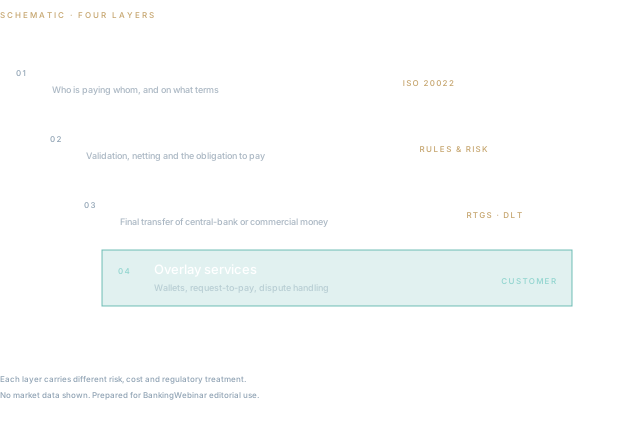
Messaging carries the instruction: who is paying whom, in what currency, with what reference data. Clearing validates that instruction, applies the scheme's rules and establishes the obligation to settle. Settlement discharges that obligation through central-bank money or, in some arrangements, commercial-bank money. Overlay services — wallets, request-to-pay, dispute handling, merchant checkout — sit on top and shape what the customer actually experiences.
Each layer has its own upgrade cycle. Messaging can migrate to a richer standard in a defined programme. Clearing rules need scheme governance and participant agreement. Settlement infrastructure is often national, systemically important and expensive to replace. Overlay services move fastest because they compete for users.
Instant payments expose the seams
Instant credit transfer schemes compress the time available for fraud checks, liquidity management and exception handling. A model designed around end-of-day batches cannot simply be accelerated. It has to be re-engineered.
The pressure appears in three places. First, liquidity: prefunded or continuously funded positions replace the cushion that deferred settlement used to provide. Second, fraud: irrevocability moves the moment of loss earlier, and recovery depends on how quickly a receiving institution can act. Third, operations: reconciliation and customer support must work at the same speed as the rail.
Speed is not a feature bolted onto a payment system. It changes where risk sits.
Schemes that succeed tend to publish clear participation rules, standardise the data carried with a payment, and give receiving institutions practical tools to screen and return funds. Schemes that struggle often modernise the message while leaving clearing and dispute processes untouched.
The data layer is the differentiator
Richer payment data is often described as a compliance burden. In practice it is the foundation for straight-through processing, sanctions screening that produces fewer false positives, and reconciliation that does not require manual repair.
Adoption of ISO 20022 is a multi-year migration, not a switch. Institutions have to map internal fields, test end-to-end with counterparties and keep coexistence arrangements running while the market moves. The risk is not that the standard fails; it is that half the chain implements it well and the other half strips the data out at the first boundary.
What supervisors are asking
Supervisory interest in payments has shifted from pure settlement risk toward operational resilience and consumer outcomes. Institutions are increasingly asked to demonstrate that they understand their dependencies: critical third parties, cloud concentration, interbank scheme membership and the recovery time of each service.
That is a governance question as much as a technology question. A bank can outsource processing; it cannot outsource accountability for the customer's ability to pay and be paid.
What to watch next
Three developments deserve attention. The first is the slow integration of domestic instant schemes into cross-border arrangements, where FX and compliance remain the binding constraints. The second is the emergence of tokenised settlement experiments, most of which are still wholesale and limited in scope. The third is the redesign of fraud liability as instant payments become the default.
None of these replaces the fundamentals. A payment system is trusted when it is predictable, when exceptions are handled fairly, and when the participant list is clear. Everything else is an improvement on that base.